For Those Who Are Struggling to Adapt to the Vastness of Research
Being thrown in the deep end is an understatement.

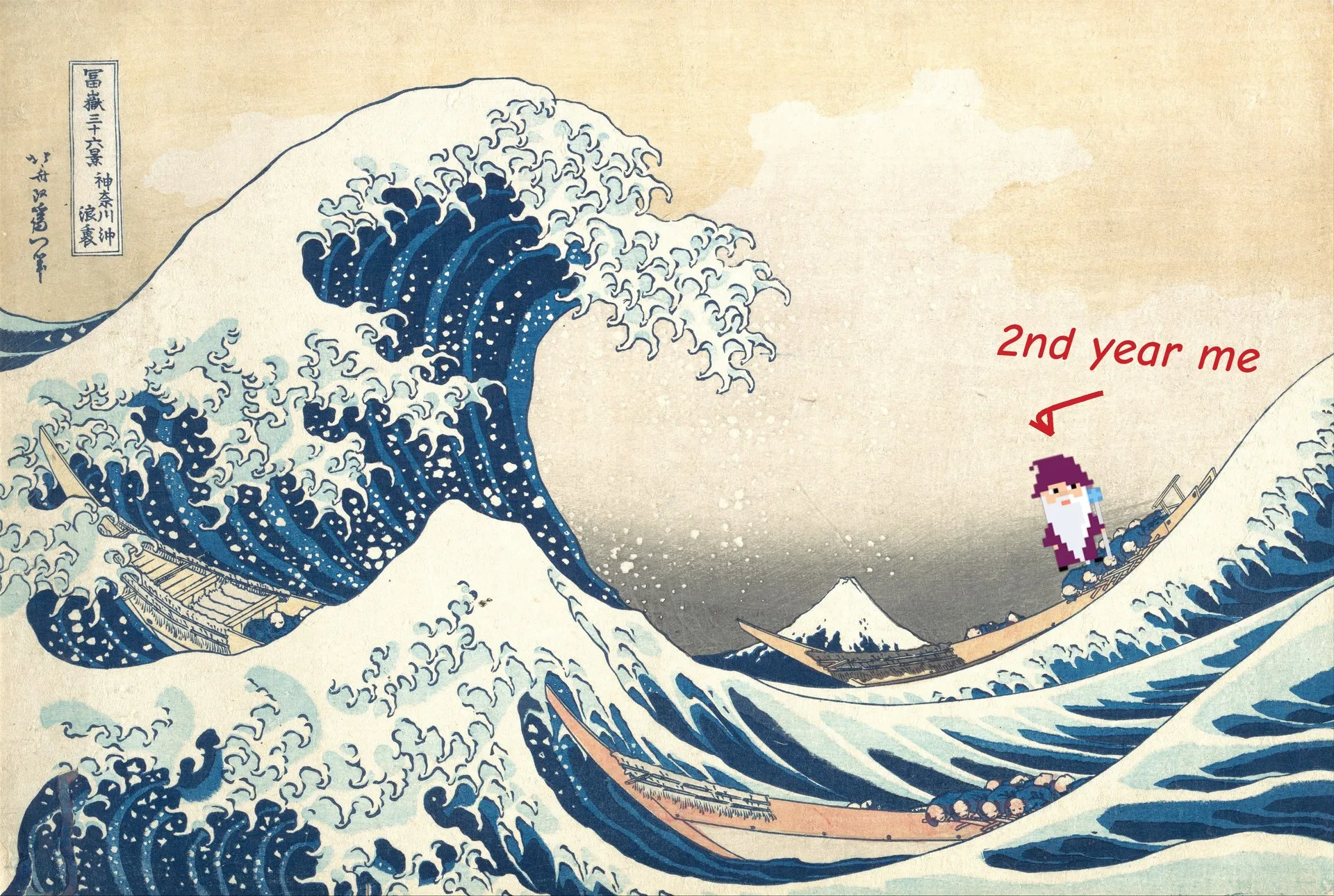
Image Credit: Katsushika Hokusai, The Great Wave off Kanagawa (c. 1831), public domain (with one small addition)
Some time after starting my PhD I realized that I was completely lost. I’m sure that I was not alone in this, especially among those who started their PhD straight out of undergrad. I want to share some of my experience for my own catharsis, and in the hopes that somebody will relate to it and know that they are not alone. (Failing that, maybe I will at least give somebody the comfort that things could be going worse for them.)
Being thrown in the deep end is an understatement for how it felt starting my journey as a researcher. It was more like being thrown into an ocean, and that ocean contains the accumulation of all the knowledge that could possibly be relevant to my project. It took me a while, but when I internalized that I was in this ocean, it was paralyzing. It’s nice when things are relatively tidy and self-contained, the way they are when you take classes during your undergrad. The lecture slides are sequential and (hopefully) coherent, the homework assignments are designed to be solvable if you’ve studied the well-defined course material, and at the end you get a number that tells you how well you did. I didn’t realize it at the time—because I didn’t know it any other way—but I was really relying on this structure. I am jealous of those who I imagine were immediately thriving in the freedom of the boundless ocean, no longer constrained by that same structure that kept me afloat.
I was overwhelmed by the vastness of existing knowledge and my own inferiority in comparison. When I tried to formulate or solve a problem, I was hit with thoughts like: “Somebody else must have already thought about this, somebody much more intelligent and knowledgeable than you at that. Maybe it is even published or well known”, and “There must be some key information out there that would make this problem trivial to solve, but you have no hope of finding it”. Studying the literature I was overwhelmed in a similar way. It has no starting point and no bottom. Sometimes I found myself going down seemingly endless rabbit holes of preliminary information trying to understand a single result or definition. I found that I lacked the background to appreciate, or even have a basic grasp of the content of a paper I was reading, and so I would jump to one or more of the cited papers and repeat the process there. In retrospect, I was still doing a lot of learning, but at the time it felt more like I was just getting lost instead of achieving my goal.
It began to feel pointless to attempt going in any direction at all—this is what I mean by paralyzing. Exacerbated also by personal struggles at the time, my thoughts turned more towards self-doubt and I developed imposter syndrome, some of which survives until today. My inner voice became more mean and hopeless: “You aren’t capable of this. There is no point in trying. Somebody else would be able to do this easily”. An imaginary seasoned mathematician laughed at my incompetence, downplayed my achievements, and questioned whether I should be doing a PhD at all. My productivity and creativity suffered under feeling often paralyzed, and made worse by feelings of inadequacy and hopelessness, I ended up in a self-reinforcing cycle. Eventually I struggled to do any work at all, and my mental health declined a lot.
It took me a while to realize what was happening, I’m not sure why. Maybe the buildup was gradual and subtle, or maybe I interpreted these difficulties as problems with me as a person. In any case, I knew that something needed to change. At times I was mindful, and I noticed that many of my thoughts were unhelpful at best and outright untrue at worst. But of course, knowing rationally that a thought pattern is unhelpful doesn’t necessarily make it go away—in my opinion, one of the most frustrating facts of life. It took a lot of learning and introspection for me to get to a better place. It was a transformative experience, but I imagine that it is too personal to be of much interest here.
If you are going through something similar to what I have described, I wish you all the best. If you want to talk about it, feel free to contact me or just vent in the comment section. I also welcome any other comments, particularly practical advice from those who have overcome a similar experience to those who are finding themselves in the middle of it, since I am aware that this is something which my post is sorely lacking. Thank you for reading.

Leave a comment